Incoming English 9H Summer Assignment
In this REQUIRED assignment, you will read the novel The Secret Life of Bees.
Please read this ENTIRE packet before beginning.
Novel Notes
Themes:
- Mothers and Daughters/Family Ties
- Self determination/self identity
- Friendship and Jealousy
- The universal need for love
- Social equality/race relations
Essential Questions:
- How does prejudice affect our understanding of others?
- How do our society and family influence us?
- How can society’s wrongs be righted?
- What qualities or characteristics do individuals possess that allow them to challenge societal expectations?
- Why do people keep secrets?
- How do people recover from pain and conflict?
- How do children become adults?
Part I: Pre-reading Questions
Complete these questions before reading the novel A Separate Peace. Each response should be 50 – 100 words.
- Consider your relationship with your family. Have you ever had rocky moments? How have those moments affected your relationship? How did they affect you as a person?
- Sometimes we can be our own worst enemy. Think of a time when you let your own thoughts (jealousy, fear, hatred, etc.) get the best of you. What happened? How did it affect you and those around you? What did you learn from it?
VOCABULARY LIST
Highlight the following vocabulary words any time you come across them.
- presumptuousness
- spectacle
- orneriness
- conjure
- cox
- snuff
- carousing
- luring
- sashaying
- unperturbed
- riled
- brazen
- pious
- blaspheme
- elusive
- salvation
Fill in the chart you were given with the printout to help you retain the words and their meanings.
Part II: Reading and Annotation
The theme in a story is its underlying message, or ‘big idea.’ In other words, what critical belief about life is the author trying to convey in the writing of a novel, play, short story or poem? This belief, or idea, transcends cultural barriers. It is usually universal in nature.
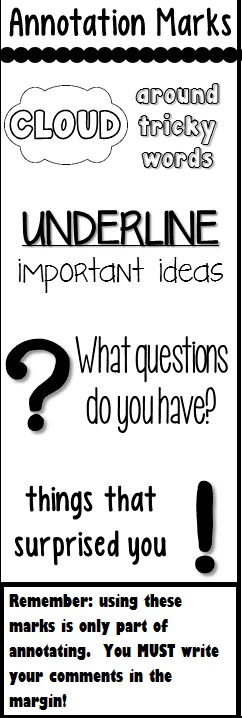
The themes of The Secret Life of Bees are listed on the above. As you read, annotate your book when you find evidence of these themes. Highlight phrases and sentences and write your comments in the margins. You may use this method:
Circle unfamiliar words.
Use a star when you read something of particular importance.
? Use one question mark if something you read raises a question in your mind.
! Use an exclamation point when something is surprising or interesting.
THEN write in the margin. Your writing can take several approaches, and the approach can change from annotation mark to annotation mark. You can write comments that are:
Opinion Your perspective on the concrete detail
Interpretation Your explanation of something about the concrete detail that you
have cited
Insight Your discussion of the basis for or nature of the concrete detail
Personal Reaction Your gut feeling or emotion regarding the concrete detail
Evaluation Your judgment regarding the value of the concrete detail you
might not be immediately clear to the reader
You should annotate frequently as you read to increase your understanding of the text.
Use this bookmark as you read so that you become practiced at this annotation method.
Part III: Written Analysis
Think about the book you have just read. Using one of the essential questions, create a thesis statement that will serve as the basis for a literary analysis essay. Write a four-paragraph essay that uses specific details and textual evidence to prove your thesis. The essay must include an introduction and a conclusion.
EXAMPLES:
If the essential question was, “What factors seem to be a threat to friendship?”,
a thesis statement might be, “Even though friendships can be very strong, many issues can threaten a connection between friends, such as jealousy, competition and growing apart.”
If the essential question was, “What does the author’s attitude toward war seem to be?”,
a thesis statement might be, “Despite the obvious horrors of war, John Knowles seems to believe that war is a necessary evil that is necessary for the world to change for the better.”
In your response, be sure to:
- Use strong and thorough evidence from the text to support your analysis
- Organize your ideas in a cohesive and coherent manner
- Maintain a formal style of writing
- Follow the conventions of standard written English
 Dellatte Online